Reputed mob associate Mickey Davis, in background, leaves federal court in Chicago Tuesday. |Brian Jackson/Sun-Times Media
It was a scene straight out of a mobster movie.
Michael “Mickey” Davis stepped into the Melrose Park used-car dealer’s office, shut the door and took a seat. He dropped a sheet of gambling debts on R.J. Serpico’s desk and growled, “this wasn’t the f—ing agreement.” Then he leaned back in his chair, and he asked two simple questions: “How are your wife and kids? Do you still live in Park Ridge?”
That moment in January 2013 could have come straight from Hollywood, a federal prosecutor wrote this month. But “when you grow up in Melrose Park, the mob is not fiction or something that you only see in movies,” Assistant U.S. Attorney Heather McShain said. Six months after that confrontation, she said Davis ordered Serpico’s “f—ing thorough beating.”
But it never happened. The “300-pound muscle guy” hired to break Serpico’s legs turned out to be a government informant. And Tuesday, U.S. District Judge Samuel Der-Yeghiayan sentenced Davis to four years in prison for extortion and attempted extortion.
Mob associate Mickey Davis appears to try to hide behind a water bottle as he leaves federal court in Chicago Tuesday. | Brian Jackson/Sun-Times Media
“No one is above the law, and the means used, breaking legs, should only be seen in the movies,” Der-Yeghiayan said.
Davis’ attorney, Thomas Anthony Durkin, asked the judge for mercy Tuesday. He said Davis has led an impressive life considering his hardscrabble background
He also said Davis has had mini-strokes and is in need of “serious medical treatment.”
Davis declined to speak at length to the judge before his sentencing, saying only, “I think Mr. Durkin said it all.” Outside the courtroom, Davis had no comment either.
Davis, 58, grew up in a “rough and tumble” Logan Square of decades past that “would be more familiar to Studs Lonigan and Studs Terkel, than today’s trendy coffee shops and fine dining restaurants,” his lawyers wrote.
The feds say Davis became “wealthy, successful, and supported by his family and friends.” But he associated with known members of the Chicago Outfit and even vacationed with Pete DiFronzo, a man described in trial testimony as the Outfit’s “street boss.”
Davis loaned $300,000 to R.J. Serpico and his father, Joe, in Spring 2012 to start Ideal Motors, a used-car dealership in Melrose Park. Davis expected his money back within three years, as well as $300 for every car sold. But the dealership was already in financial trouble within a few months, and Joe Serpico “had a serious gambling problem,” prosecutors said.
When the dealership stopped holding up its end of the bargain, Davis confronted R.J. Serpico in his office, throwing around a sheet of Joe Serpico’s gambling debts, as well as veiled threats like, “How old are your kids? Does your wife still have that salon in Schaumburg?”
When Davis was finished, prosecutors said he stood up, leaned over the desk, stared at R.J. Serpico, and left.
Davis later convinced R.J. Serpico to fire his father. Serpico told a jury that he feared Davis. He said he saw Davis driving around with DiFronzo and thought to himself, “what did I get myself into?” He agreed to sign over the title of a Chevrolet Chevelle to Davis, who sold it for $30,000, records show. He also paid Davis an additional $30,900.
But Serpico walked off the lot of Ideal Motors in May 2013, never to return, according to the feds. Davis allegedly arranged for a friend to take over operations and had the vehicles towed to a lot owned by DiFronzo.
In June or early July 2013, the feds say Davis arranged for Serpico’s “break-both-legs beating” by contacting Gigi Rovito, who recruited Paul Carparelli, who reached out to George Brown. Carparelli told Brown the person who ordered the beating was “Mickey” who was “Solly D’s partner” — an apparent reference to Chicago Outfit member Salvatore DeLaurentis.
Brown initially mistook R.J. Serpico for the son of Melrose Park Mayor Ronald Serpico, records show. R.J. Serpico is actually the mayor’s nephew.
The feds say Davis dropped off a $5,000 down payment for the beating at Rovito’s Capri Ristorante on July 11, 2013. But Brown turned out to be a federal informant. Carparelli was arrested July 23, 2013, and now faces sentencing in a separate extortion case Dec. 21. Davis was indicted in March 2014.
Meanwhile, the feds say they used cell phone data to track Davis’ movements the day he dropped off the $5,000.
They said he had come that day from the Itasca Country Club, where he played a round of golf with, “or immediately next to,” DiFronzo.
In honor of the Chairman of the Board's 100 birthday, four books for fans to savor.
A hundred years ago this Dec. 12, under the sign of Sagittarius, in the shadow of World War I and in the gritty embrace of Hoboken, N.J., Natalie Catherine Garavente Sinatra — "Dolly" — gave birth to a boy named Francis Albert. What happened next, in the fast-forwarded meaning of that word, has written itself as much as it has been written via a Babel-like tower of books, articles, liner notes, gossip columns, lecture notes, film scripts, websites and fan scribblings.
Now, on the cusp of this milestone moment in Sinatriana, long after RPM stopped meaning anything, we are being treated to yet more books about his time on Earth, the place he occupies in American culture and the role he plays in our lives.
The question is, particularly in the wake of HBO's two-part, four-hour documentary, "Sinatra: All or Nothing at All," are you ready to dive back into the subject?
For hard-wired Frankophiles, of course, there is no such thing as too much, meaning that "Sinatra: The Chairman," James Kaplan's nearly 1,000-page sequel to his 800-page doorstop of 2010, "Frank: The Voice," couldn't have come a moment too soon.
For fans with less time on their hands, there is John Brady's "Frank & Ava: In Love and War," a polished recap of Sinatra's thorny, epic romance with the goddess-like Ms. Gardner that is padded with unrelated material but goes down smoothly.
David Lehman's browser-friendly "Sinatra's Century" offers "One Hundred Notes on the Man and His World" — "Godfather" references, Elvis Costello's analysis of Sinatra's vocals, the anagrams in Sinatra's name, a list of Italian singers and their real names.And Pete Hamill's slim but illuminating elegy, "Why Sinatra Matters," first published after the singer's death in 1998, has been reissued with a new introduction by the author.
"The Chairman," clearly the main event here, picks up the story in 1954, when a best supporting actor Oscar for "From Here to Eternity" fueled Sinatra's remarkable comeback from a painful downturn in his career — and his downward spiral after Ava Gardner's arrival in Nevada to spend the required time in residence for her divorce suit against him.
With Sinatra's return to success came a full flowering of his extremes. Here was a man who was capable of the most loutish, temperamental behavior and the sweetest, most generous gestures; the truest friend anyone could have (ask Sammy Davis Jr.) and the world's worst grudge-holder; a man committed to important social causes even while drawn to the Mafia.
During these tumultuous years in his life, Sinatra reached incomparable heights as a singer and interpreter of song. In due course, he invented the concept album with the brooding masterpiece, "In the Wee Small Hours of the Morning" (1955). He perfected his hard-swinging, ring-a-dingy sound and, under the influence of Billie Holiday, re-equipped his style (and redefined the popular vocal) with deep adult emotion.
We learn from Kaplan that Sinatra, an only child who "lived with loneliness" and torment, was constitutionally unable to stay in one place or be by himself. To combat the chronic suffering that dogged him his entire life, he had to keep in motion, preferably surrounded by friends. The original Rat Pack, including Humphrey Bogart and Lauren Bacall (with whom he became romantically entangled while Bogie lay dying) was the ultimate in great company — though the Dean Martin version was no slouch when it came to carousing.
Sinatra may have celebrated matrimony with his 1955 hit, "Love and Marriage" (written for a TV production of "Our Town"). But wedlock never prevented him from playing the field. There was no beauty the powerful and charismatic Sinatra could not get into bed (he made a list of the ones to go after), including Marilyn Monroe.
Following her divorce from Joe DiMaggio, Monroe was going through a difficult period — too difficult for Sinatra to cope with on his pleasure yacht. "I was ready to throw her right off that f— boat," he is quoted as telling an associate. Citing opposing sources, Kaplan is inconclusive about which party was more smitten, but he is happy to write, per Sinatra's longtime valet, that the singer was "disgusted by Marilyn's slovenliness and disdainful of her intellect." Kaplan also can't resist a frowning assessment of Monroe's physical state, based on a photograph of her with Sinatra, describing her as "overweight — her chin is double — and … distinctly less than glamorous."
How much you'll want to read about Sinatra's romantic misadventures with Ava Gardner, detailed in three of the books (Lehman has them on a drunken joy ride in Palm Springs shooting out streetlights and store windows with .38s) will depend on your stamina. Here was a matchup of two demanding, extravagantly self-centered souls who helplessly clung to the idea of their romance long after their disaster of a marriage ended.
Would Sinatra have poured such depths of feeling into songs such as "I'm A Fool to Want You" had he not suffered over the loss of his green-eyed goddess? Kaplan is not alone in saying no. The deepening of Sinatra's voice physically, on the other hand, was a consequence of his drinking and sleepless nights. There were times his instrument was so damaged he was unable to use it.
Like its subject, "The Chairman" has to keep moving. Its subjects range from Elvis Presley, who with his higher popularity rating would have gotten under Sinatra's skin even if he didn't play that hated rock 'n' roll, to Mia Farrow, whose May-December marriage to Sinatra inspires some of the book's most insightful writing, to the casino manager who socked Sinatra in the face.
Sinatra, whose prodigious sex drive gave him and John F. Kennedy something in common — "Sinatra's Century" contains Rat Packer and Kennedy in-law Peter Lawford's admission that "he was Frank's pimp and Frank was Jack's" — campaigned hard for his friend and produced his inaugural celebration.
Sinatra had arranged to have JFK stay with him during a trip to California early in his presidency. But tainted by his association with Sam Giancana and the Chicago mob — which he allegedly enlisted to muscle votes for Kennedy in key states — Sinatra got stood up. Kennedy stayed instead with Bing Crosby — a hard-line Republican. (Helplessly drawn to power, Sinatra later palled around with Richard Nixon and Spiro Agnew.)
In stringing all these chapters together, Kaplan comes across as part tour guide and part bricklayer. But though he contradicts himself on Sinatra's capacity for joy, and all but ignores the pretentious pile-up that was Sinatra's three-album opus, "Trilogy: Past Present Future," he offers sound evaluations of key recordings and solid reporting on celebrated sessions. Sinatra was at constant war with his record labels. To punish Capitol for not rewarding him enough, he recorded the songs for "Sinatra's Swingin' Session!!!" at twice the normal tempo (it was a hit, nonetheless). He also fell out with most of his arrangers. In a lovely gesture to a dying man, he brought back Axel Stordahl, one of his earliest arrangers, for "Point of No Return," his Capitol swan song. But in the studio, he treated him shabbily.
One can only hope that when Sinatra began forgetting lyrics he had sung thousands of times, the people around him were kinder. He may have been a cad, but he was our cad — a transcending soul who has continued lifting our lives on a daily basis.
Mobster Anthony Spilitro, right, does the perp walk in 1983 following his racketeering arrest. He is accompanied, right to left, by FBI agent Mark Kaspar, while journalists George Knapp and Jane Ann Morrison question him. Review-Journal file pho
By Jane Ann Morrison Las Vegas Review-Journal
Although I have never been a perp, I participated on a famous perp walk in 1983 and have the black-and-white photo to prove it.
The perp was later-to-be-murdered mobster Anthony Spilotro. The serious-looking FBI agent walking him by the press was Marc Kaspar.
The journalists waiting to ask questions that wouldn't be answered were George Knapp and the R-J's federal court reporter at the time. That would be me. The one with the Afro.
During a panel Saturday, Kaspar told the behind-the-scenes story of that perp walk outside the Foley Federal Building.
Spilotro had been indicted on racketeering by a federal grand jury, and Kaspar went to arrest him. The two men had known each other for years because Kaspar has been on the FBI's Las Vegas organized crime squad since coming to Las Vegas in 1977, and the squad's No. 1 target was the Chicago mob's enforcer.
You would think they would be bitter enemies. Not so. When Spilotro was arrested, Kaspar didn't even use his handcuffs. Until they got close to the federal building and Kaspar said, "Tony, I've got to put handcuffs on you."
Spilotro offered his hands up, he was cuffed, and they did the perp walk. Kaspar knew what he had to do, so did Spilotro; it was all very professional.
Kaspar has donated those cuffs to the Mob Museum, which hosted the Saturday panel discussion of what was real and what was fiction in the 1995 movie "Casino."
Kaspar was speaking out publicly for the first time about his experiences as the case agent in the Spilotro investigation.
Oscar Goodman gave his views from the perspective of the attorney representing Spilotro and his chum Frank "Lefty" Rosenthal.
Former Gaming Control Board member Jeff Silver spoke about his role chasing the mob as a state regulator. Former FBI agent Deborah Richard told her experience in two previous columns, and retired television reporter and anchor Gwen Castaldi told of the challenges facing journalists covering the mob in the 1970s and 1980s.
As Castaldi said, without cellphones and the Internet, it wasn't easy, especially because news about the mob in Las Vegas was frequently connected to news about the mob in Kansas City, St. Louis, Milwaukee, Detroit and Chicago.
Kaspar told about a 1981 search where the subject — in this case Stardust employee Phil Ponto — had been tipped. The agents searched his apartment looking for marked money that had been skimmed from the Stardust.
The safe was opened, and inside was nothing but Ponto's Social Security check.
It was Ponto's way of flipping off the FBI, much like the simultaneous search that resulted in agents coming up with cookies and a bottle of wine in a car trunk.
While there were plenty of laughs Saturday, there were serious moments. Kaspar said he tried to be diplomatic, but he pushed back against Goodman's statements he believed were not true.
Goodman said things such as Spilotro didn't curse, he and Geri Rosenthal didn't have an affair, Rosenthal was not an FBI informant, and federal Judge Harry Claiborne had not leaked FBI wiretap information to the mob.
Goodman, who went on to become mayor of Las Vegas for 12 years, went on a tirade against former FBI agent Gary Magnesen, who had written in "Straw Men" that he believed the late Claiborne had leaked information from FBI search warrant affidavits so mobsters knew in advance about the searches, which resulted in cookies and a Social Security check.
"Harry Claiborne lived with this accusation until he took his own life," Goodman said angrily.
Except Magnesen's book was published in 2010 and Claiborne committed suicide in 2004. The timing is off.
Kaspar said he believes Claiborne was the leak. "He was the one who signed the wiretap order on the Stardust," the retired agent said. "When I heard that, I told the case agent we'd find nothing but cabbage," he said, referring to the 1981 Ponto search.
Magnesen now believes, as I wrote in last Thursday's column, that mob associate Rosenthal was a double agent and tipped mobsters off to upcoming searches. Magnesen said Rosenthal became an FBI informant around the time he wanted to get a gaming license, an effort that began in 1975. "He wanted the FBI to help him with his gaming license — which we didn't do."
In a tirade, Goodman denied Rosenthal was an informant. "It's poppycock."
Of course, would Rosenthal have admitted it to his attorney?
I confirmed it back in 2008 with three sources. Magnesen said it on the record, and Kaspar said, "I have reason to believe he was." Richard also said he was an informant based on what she had been told. But Goodman doesn't believe it.
Goodman asked if Spilotro was such a bad guy, killing more than 20 peoples, why wasn't he convicted?
"He was never convicted because he got rid of all the evidence," Kaspar said, referring to witnesses who died or disappeared. "I always said we would never convict Tony, that he'd be taken care of by his own people."
Spilotro and his brother Michael were killed, then buried, in an Indiana field in 1986.
"I'm not sure anybody in law enforcement wanted to solve his murder," Goodman said bitterly. He complained no one from law enforcement asked if he had any idea who killed Spilotro.
"You wouldn't tell anyway," Kaspar responded.
Kaspar and Goodman took opposite views on the 1982 bombing of Rosenthal's car. Kaspar believes it was ordered by Spilotro. Goodman made the comment that different families had different styles, and the Kansas City mob leaned toward car bombings. That was identical to Magnesen's opinion, who contends the bombing was ordered by Kansas City mob boss Nick Civella, another of Goodman's clients.
Goodman said the movie captured Rosenthal "but took a lot of license as far as Tony is concerned."
He said Spilotro didn't curse as Joe Pesci did in the movie and was very polite.
Richard, who surveilled the mobster, said Spilotro probably treated his defense attorney "differently than the people he extorted."
Kaspar said the wiretaps showed that Spilotro did curse, and surveillance photos he took himself showed Spilotro and Geri Rosenthal meeting. Their affair was a major storyline in Nick Pileggi's book based on Rosenthal's recollections.
To give Goodman the last word: "Those folks would still be running casinos if they weren't so greedy."
Seems like he's in a position to know, even if his memory can be faulty.
During my tenure as the Chief Investigator I wrote a column for our quarterly news letter. Here is a look at the past.
THE CHIEF SAYS.....
by Chief
Investigator, Wayne A. Johnson
ORGANIZED CRIME IN
CHICAGO
Crain’s Chicago Business has stepped up to the
plate, and in my opinion hit a triple. Their summer report regarding recent
misappropriations of the North Loop tax-increment financing district known as
(TIF) funds sends a strong message to those handing out no-bid contracts for
the City of Chicago. The message is: “ we are watching”. It seems this story
has raised some concerns in City Hall, and just maybe certain companies,
especially those with Organized Crime ties, will not be awarded such valuable
contracts or do business with the City at all. There are just too many quality
companies out there, to being doing business with the Chicago Outfit.
UNION NEWS
Since July of 1997, the City of Chicago has hosted
hearings by the Office of the GEB Attorney, of the Laborers’ International
Union of North America. The hearings are being conducted by Peter F. Vaira, an
Independent Hearing Officer and have been held at the Chicago Federal Building
and The Midland Hotel in downtown Chicago. These hearings are in response to a
Complaint for Trusteeship filed by the GEB Attorney who is charged with the
oversight of the Union. In laymen’s terms this is an action put forth that can
take control of the union away from those now in power. The reason for this
action is that investigators foundindividuals who are serving, or have served as officers, trustees, and
employees are members,associates, or
relatives of“Chicago Outfit” members.
Twenty-Three individuals were characterized in this manner and listed in the
Complaint. This is very unsettling for the vast majority of the union
membership, who are honest, hard working, dues paying members. The Chicago
Crime Commission took great pride in working with attorneys and investigators
to carry out these hearings. A finding should be released by the end of 1997
and we wait with great anticipation and hope that such unscrupulous individuals
are removed from the union.
VIDEO POKER MACHINES
The Gambling Committee of the Chicago Crime
Commission has identified Video Poker as a primary source of concern in our
efforts to fight legalized Gambling in every front. In a fact finding process
the Committee
members were presented with an initial report.
This report synopsizes some very startling facts regardinggambling and the beginning stages of the
epidemic. Environmentally it is a shared belief that kids are encouraged to
gamble because it is considered cool by their peers. Along with that belief we
also see that video arcades prepare these young gamblers for an easy transition
to activities such as Video Poker. A recent high school survey showed that 2/3
of the kids in a northwest suburban high school gamble in some manner. This
information has led to belief by the Chicago Crime Commission that states:
“Gambling is not dangerous because it is illegal, it is illegal because it is
dangerous”.
Frank Cullotta keeps reaching toward his face, trying to adjust something no longer there. His glasses. Cullotta just finished a series of Lasik surgeries to right his vision. Gone are his recognizable, oversized frames. He now sees clearly but continues to focus his memory in the long-ago past.
Cullotta was a famous hit man for the Chicago Outfit, a self-described former “gangster, burglar, murderer, extortionist, arsonist” who admitted to the 1979 killing of con man Sherwin “Jerry” Lisner in Las Vegas. As was customary in those days, Cullotta acted on the order of Chicago Outfit overlord Tony Spilotro. The murder scene was depicted in the film “Casino.”
Cullotta was a consultant on the film, as he edged his way back into society while living under an assumed name. He spent two years in the federal witness-protection program after cutting a deal with the federal government in exchange for information about his former associates.
Today, the 76-year-old Cullotta earns a legal living as an expert in the culture that led him underground. He works as a guide for the Mob Museum, leading “Casino” tours of the primary points of interest featured in the 20-year-old mob movie, most of which was set in Las Vegas. The tours begin at the Mob Museum with a private walk-around hosted by mob historian Robert George Allen and include a bus tour of the city’s famous mob locations. The five-hour tours run monthly and cost $180, including a champagne toast and pizza dinner.
Guests visit such locations as the Casino House, where Cullotta carried out the Lisner murder; the setting for the Frankie “Blue” death scene in the film; the Las Vegas Country Club clubhouse where Spilotro and Moe Dalitz used to play cards; and the site of the Hole in the Wall Gang’s botched Bertha’s Household Products robbery on July 4, 1981, which led to Cullotta’s arrest. The bus also pulls into Piero’s Italian Cuisine, also used in “Casino.”
You see, too, the spot at Tony Roma’s on Sahara Avenue where in 1982, Lefty Rosenthal was nearly killed in a car-bomb explosion, spared by the hard-metal plate under the driver’s seat of his ’81 Cadillac Eldorado.
“I tell people that Lefty was a creature of habit,” Culotta said. “He always liked to have his ribs at Roma’s, once a week. He was an easy target.”
Cullotta is introduced to those on the tour by “Casino” book author Nicholas Pileggi. “He brags about me, saying there would have been no book or movie ‘Casino’ if it was not for me,” Cullotta said.
Cullotta considers the obvious: He is the rare (hopefully) person taking these tours who actually has committed a murder.
How does it feel to be walking around with that experience, even more than 35 years later?
“Honestly, it never wakes me up,” Cullotta said. “If you do think about it, it’ll put you in the (effing) nuthouse. When I do these tours, then everything pops up into my head; people want to know if it bothers me. Of course. But if I thought about it 24 hours a day, I’d wind up in my car with a gun in my mouth.”
Cullotta says he compares his experience to that of a serviceman carrying out an order for his government. “It’s like fighting a war,” he said. “I hate to use the military as a comparison, but that’s how it felt; I was carrying out an order.
“People are fascinated by me, and I understand that, but there’s a big difference in me today than there used to be. I mean, I used to be surrounded by celebrities, showgirls, politicians, a lot of money, people wanting to attach themselves to you. But it came at a price.” Which was? “I lost my freedom,” Cullotta said. “I had to change my life completely. But I have paid my debt to society. I’m under no pressure. I used to have headaches all the time, from tension, and I don’t have headaches anymore. I’m clean today. I’m very clean.”
Once upon a time, Michael “Mickey” Davis wanted a deadbeat car salesman hurt in a “break-both-legs beating” for failure to pay up on a $300,000 debt.
Davis, who grew up with men who now run Chicago’s Outfit, enlisted an Italian restaurant owner from Burr Ridge to find the bone breakers for him. The restaurateur went to mob associate Paulie Carparelli, who turned to a union bodyguard, George Brown, to wrangle the necessary goons.
But Brown — a “300-pound muscle guy” — was working for the FBI. After scaring another businessman who owed someone money into wetting his pants, the FBI busted Brown and persuaded him to wear a wire on Carparelli.
So much for that whole “I gotta guy” thing, right?
And that’s how the plot to hurt R.J. Serpico, a used-car dealer in Melrose Park, ended with Carparelli and Davis in handcuffs and eventually behind bars. Convicted this summer of extortion, Davis, 58, appeared before a federal judge Tuesday, who handed him a four-year prison term as his wife doubled over in tears in the courtroom gallery.
His defense attorney asked for 13 months, arguing Davis is the kind of man with a “genuine concern for the well-being of others, willingness to help those in need, and generous spirit.”
At trial, federal prosecutors wanted the jury to know just how deep Davis’s connections to the mob run, and how generous of a beating he wanted for Serpico.
Davis made millions of dollars collecting debris at the E.F. Heil Landfill in Plainfield from the construction companies owned by his reputed mobster buddies, Peter and John DiFronzo, friends from his boyhood days in Chicago. Davis is business partners with Salvatore “Solly D” DeLaurentis, described as a “feared capo” in the Chicago Tribune trial coverage, who’s done time for racketeering.
During court proceedings, federal prosecutors explained how Davis has long been connected to the DiFronzos and DeLaurentis, who run the Elmwood Park crew of the Chicago Outfit.
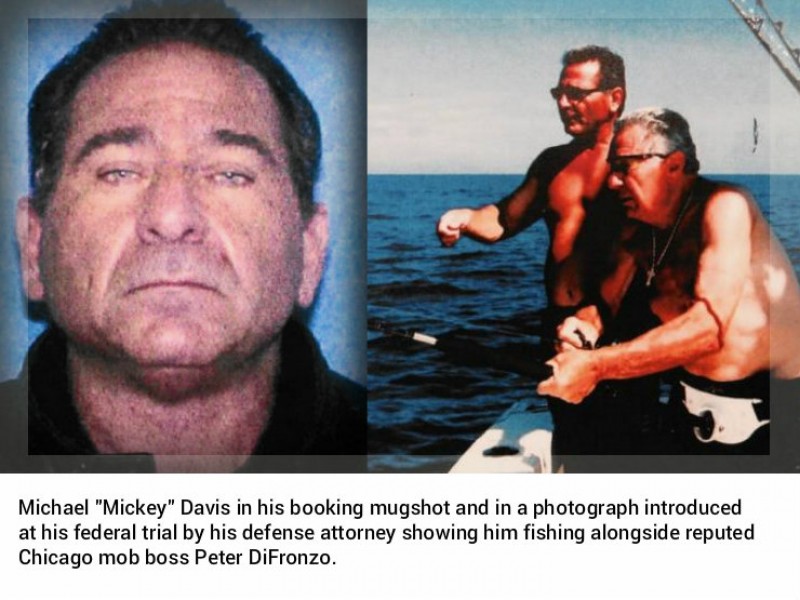
In response, his defense showed the jury a photo of a shirtless Davis and a shirtless DiFronzo deep-sea fishing on a boat in Costa Rica. The DiFronzos may be Chicago’s best-known reputed mobsters these days, his attorney suggested, but “Mickey” Davis and and the DiFronzos are “just friends.”
Why Davis didn’t go to his childhood pals to find thick-knuckled goons to beat down the used-car salesman instead of getting help from a restaurant owner wasn’t discussed at trial.
A topic of much discussion, however, was how petrified R.J. Serpico was as he fretted about what Davis might do to him.
Serpico and his dad borrowed $300,000 from Davis in 2012 to start a used-car dealership in Melrose Park. The loan would be paid back in 2015. But Serpico’s dad racked up a rather large debt with a bookie using the borrowed money, according to court records. And Serpico wasn’t very good at selling used cars, so the business was failing.
Serpico, 44, a married father of two, testified about the January 2013 day Davis visited his dealership, Ideal Motors, with a not-so-subtle message: “This wasn’t our (effing) agreement,” Davis told him, showing him a piece of paper with an accounting of his father’s debt. “I want my (effing) money.”
Before Davis left came the threat.
“How are your wife and kids doing? Are you still living in Park Ridge? Does your wife still own that salon in Schaumburg? ”In the months that followed, reports the Chicago Sun-Times, the car dealer would “vomit often” out of fear.
According to testimony offered at Davis’s trial, Serpico tried to pay down some of his debt by giving Davis a used Chevelle and $60,000 in cash. Eventually, Serpico signed over Ideal Motors entirely to Davis in May, according to prosecutors. But Davis still wanted Serpico hurt. Hurt bad. As he put it, a “break-both-legs beating.”
So he went to Carparelli. Who went to Brown. Who, fortunately or unfortunately, depending on your sympathies, was already in the clutches of the FBI. “OK, listen, I met this guy yesterday. You know who this guy is? This is Solly D’s partner. OK? ... So, listen, we definitely can’t (expletive) around with these guys or we’re going to have a big (expletive) headache, a big headache,” Carparelli said in a tapped phone call in July 2013. “The guy already gave the down payment. He’s a (expletive) mean mother(expletive). I don’t wanna have no problems with him.”
Carparelli told Brown he was excited about this task, too, according to the feds, because he saw an opportunity to impress his bosses with how he was going to handle the beat down. And this is how Serpico would get it: The goons would set up a car accident as Serpico left his new job as a salesman at another dealership.
“Say we give him a little tap, like an accident. ‘Oh man, I’m sorry.’ Guy gets out of his car. Boom, boom, boom. That’s it.”With that, the FBI brought everybody in, saved Serpico from the beating of his life and sent Davis to prison.
IATSE Projectionists Local 110 in Chicago was once widely believed to be one of the most mobbed up unions in America — a crooked outfit packed with members of the Chicago mob and their relatives, some of whom who are now drawing generous pensions from the local’s endangered pension plan.
Today, the local still counts relatives of long-dead gangsters among its members including the nephews of Sam Giancana, who ran Chicago’s organized crime syndicate in the late-1950s and ’60s and who was murdered gangland-style in 1975, and Joey “Doves” Aiuppa, the gangster who later succeeded Giancana and who many believe was behind his killing. According to financial statements filed with the U.S. Department of Labor, Giancana’s nephew Andrew sits on the local’s executive board, a post he’s held since 2004, while seven of the local’s members and prospective members — including the local’s secretary-treasurer — were convicted on charges stemming from arson attacks on 20 theaters in the late 1990s.
Contacted by Deadline, Andrew Giancana said he is a retired projectionist, but declined to discuss his family background. Sam Aiuppa acknowledged he is the nephew of Joey Aiuppa, but declined to say how he got into the union. Neither man has ever been charged with any wrongdoing, and both are respected members of their communities. Like many other relatives of Mafioso who, over the years, were given patronage jobs as Chicago projectionists, they chose live as honest citizens.
But their presence in a union famous for handing out no-show jobs to mobsters, and as a haven for their relatives seeking legitimate employment, suggests that while digital theaters have decimated the ranks of union projectionists, the Chicago local still clings to its dark past as a union once dominated by the Chicago Outfit.
Kent Dickinson knows that history all too well. A member of the local since 1972, he was a member of the local’s negotiating committee in 1998 and spent three years in prison for his role in a wave of arson attacks on 20 movie theaters across 10 states back in 1998 and 1999, the last time the local is known to have resorted to violence to force recalcitrant employers to sign its contract. No one was killed or seriously injured in any of the attacks — the incendiary devices produced low flames and a lot of smoke — but thousands of moviegoers’ lives were put at risk including the lives of many children when they stampeded for the exits.
Kent Dickinson
“I could have been the worst mass murderer in the history of this country,” Dickinson told Deadline. “I literally thank God every day that I never hurt anybody. It may sound strange, but I believe that God was looking out for me.”
The union, which controls a $20 million pension plan that is 50% underfunded — its actuary has told the U.S. Deptartment of Labor that it’s “endangered because it has funding or liquidity problems” — has long been known as a “sandbox” for the mob and their kin. The plan is in trouble because the all-digital theaters in Chicago no longer employ any of the local’s members, and the only pension contributions flowing into it are made on behalf of members who work at trade shows and conventions.
But in its heyday, the local’s members were the highest-paid projectionists in the country, and many of those members were gangsters and their relatives. In 1978, federal investigators found that the brother and two sons of Tony “Big Tuna” Accardo, the undisputed boss of the Chicago crime syndicate, were members of the local, and that one of his sons was even an official. Federal investigators also found that eight other relatives of Accardo henchmen John Cerone, Aiuppa and Sam Battaglia were members of the union, as well.
Former U.S. Attorney Peter Vaira, who headed up that investigation, told Deadline that mobsters took no-show projectionist jobs “to show some kind of ‘legitimate’ income. A great many mobsters had jobs as motion picture operators. That’s what the union was famous for.”
In his 1978 report to President Jimmy Carter, titled “Organized Crime and the Labor Unions,” Vaira wrote: “This local has been completely hoodlum dominated since the 1930s. The history of the union is riddled with violence and murder. Until recently the president was Clarence Jalas, frontman for the late-underboss Paul ‘The Waiter’ Ricca. The union’s current roster includes names and relatives of hoodlums that reads like the syndicate version of Who’s Who. Hoodlums who would have a difficult time loading an instamatic camera are $15,000-a-year projectionists. Anthony Accardo’s son is a motion picture projector operator and union official.”
This was made possible because up until 1975, the local had a provision in its contract that required theaters to employ two operators in each projection booth. That ended 40 years ago when the local reluctantly gave up the two-man booth. “A three-screen theater would have six guys,” Dickinson laughed. “We never had six guys; we had only three. The other three guys would be no-show mob guys – real soldiers in the mob. They would come in every Friday and pick up their checks. It was done to give phony baloney jobs to people we wanted to take care of. The Chicago mob took care of Local 110, so we took care of them.” Many of those crooks are now drawing pensions from the local’s endangered pension plan.
The local’s current president Ken Rapier, and its business manager, Steve Altman, both refused to talk to Deadline for this story. Dickinson said that they are both “straight guys” and not affiliated with the mob. The local has no working website and Deadline could find no public record of when the union held its last election of officers. The local’s parent union, the International Alliance of Theatrical Stage Employees, which has not placed the local into trusteeship since 1935 — when it was controlled by Frank “The Enforcer” Nitti – also declined comment.
Muscle Behind The Projector
Up until the mid-1980s, the mob provided muscle for the local to convince recalcitrant theater owners to sign its contract. “When I became an operator in 1970,” Dickinson said, “I was told that at least one theater owner who wouldn’t sign with us ended up dead in a plastic bag in the trunk of a car. That’s what I heard. That’s what the mob did for us.”
And in return, the local gave no-show jobs to gangsters, and real jobs to their kin. “Local 110 became the outlet — the default job — for ‘family’ members who did not want to go into the family business,” Dickinson said. “It became the legitimate job for them. They became Local 110 members. They were real employees. I worked with them. I worked with John Accardo, the son of Tony Accardo. John was a real projectionist, and a good one, too. He worked at the Water Tower Place Theater.”
The local did similar favors for judges and politicians. “Sometimes when a judge would do a favor for 110, his nephew or whoever would end up a member. We put two of Mayor Jane Byrne’s bodyguards in 110, and because of that favor, we were able to put our own man on the Chicago safety commission, which wrote the rules on how boothmen could conduct business safely. That guaranteed that there could be no automation in Chicago. We wrote that rule and we kept automation out for 20 years.”
The mob’s help was more direct. In the 1970s, when porn theaters in the city refused to hire union projectionists, a few well-placed bombs got them to see the error of their ways. “The mob did that,” Dickinson said. “Several porno houses were owned by friends of the mob, and they thought they didn’t have to pay us. They were mistaken.”
Ironically, when Dickinson was a little boy, his father had owned a theater in suburban Chicago that had been bombed by the mob. “He refused to sign a union contract, and they bombed the back of the theater,” he said. “It blew the back wall out. And I grew up to be one of them.”
The local lost the backing of the Mafia in the mid-’80s after the FBI busted up the Chicago Outfit’s skimming operations at Las Vegas casinos, as immortalized in the movie Casino. After several high-profile arrests, the mob decided to lay low. “The Chicago mob was the top operators of that scam,” Dickinson said. “When the FBI cracked that case, the mob was taken down, and they cut back doing what they used to do. One thing they stopped doing was helping us. It was a bad time to be in the mob, and we lost a lot of jobs. We went from being highly overpaid to being barely overpaid. We were on our own, and that’s when I became a participant in what I did.”
Some mobsters, however, just couldn’t give up their old ways. In 1988, when the owner of the Lake Theater in Chicago refused to bargain with the local, Samuel “Wings” Carlisi, who at the time was the Chicago Outfit’s boss of all bosses, took it personally. Court records show that his son was a card-carrying member of the local, and so were the sons of two of his top lieutenants, James Marcello and Anthony Zizzo.
Carlisi dispatched his crew to bomb the theater to make the owner sign with the union. First, they tried to set the roof ablaze with an incendiary grenade, but when that didn’t work, tried a Molotov cocktail. When that failed, they threw a fragmentation grenade on the roof but it failed to detonate, and before they could come back with another bomb, a janitor found the dud and turned it over to the police. Several of the mobsters were arrested, convicted and sent to prison.
After that, the local would have to provide its own muscle, and in 1998, when contract talks with Loews theaters reached an impasse, that’s what just they did. In his tell-all book Crimes Of A Christian, Dickinson recalled how then-Local 110 boss Albin Brenkus showed him how to make a chemical bomb – one that would create the maximum amount of smoke with the minimum amount of flame. It wasn’t intended to burn down the theater or kill the customers, but to send them running for the exits, and to send the owners a message that they were messing with the wrong guys.
Sony, which owed numerous Loews theaters in the city, had just given the union its last, best and final offer for a new contract, which would have slashed the number of projectionists it needed for its automated booths by 90% and reduced the wages of its remaining workers by 50%. Leaving the Hilton hotel where the bargaining was taking place, Dickinson and Brenkus stepped into Brenkus’ car. Reaching under the seat, Brenkus pulled out a cardboard tube and shook out a white tablet. It was chlorine. “One of these mixed with brake fluid,” he said, holding it in the palm of his hand, “causes a chemical reaction that creates a cloud of smoke after about 20 minutes. Test it out. See if it works. If it does, use ’em against AMC if you want.”
AMC had just opened a 30-plex cinema in the city that didn’t employ any of the local’s members. Bombing one of Loews’ theaters in the middle of negotiations might lead the cops back to the union, but hitting AMC would give them cover. And Sony would get the message all the same.
A History Of Violence
Founded in 1915, the local was taken over five years later by labor racketeer Thomas “Tommy” Maloy, who ruled it for the next 15 years with an iron fist and lead bullets. When dissidents tried to take over a union meeting in 1924, Maloy’s men fired machine guns into the ceiling of the union hall, sending the rebels, covered in plaster dust, quietly back to their seats. In the years to come, many of those who dared stand up to him would find themselves covered in blood, gunned down on the streets of Chicago – or in his own private office.
In 1931, a Cook County grand jury opened an investigation into the local’s operations. Among those subpoenaed to testify was Jacob Kaufman, a member of the local and a longtime Maloy opponent who in June of that year announced he would challenge Maloy for the leadership. Two days before he was scheduled to testify, Kaufman heard a noise outside his house. When he went outside to investigate, a gunman fired six shots into his head, killing him instantly. No one was ever arrested.
Two years later, when Fred Oser and six other members of the local rebelled against Maloy’s rule, they were kicked out of the union. When Oser went to the local’s office seeking reinstatement, he was shot to death in Maloy’s private office by Ralph O’Hara, a known hoodlum and union organizer. A jury later acquitted him on the grounds he’d acted in self-defense.
In 1935, Maloy, who’d been shaking down theater owners for years by promising them labor peace in return for paper bags stuffed with money, was indicted for having failed to report $350,000 in income over a three-year period. That was a lot of money in those days – about $6 million today. A week later, as he was driving on a busy highway headed downtown, a car pulled up beside him and opened fire, killing him with two blasts from a shotgun and a volley of pistol shots. His killers were never apprehended.
His death coincided with the take-over of the IATSE by the infamous George Browne and Willie Bioff, who put the local into trusteeship and continued Maloy’s shakedown racket themselves. It’s the only time that the local has ever put into trusteeship, replacing one crook with two others. But Browne, the weak president of the giant union, and Bioff, his mobbed-up West Coast representative, had bigger pockets to pick, and soon began extorting millions of dollars from the Hollywood studios in return for labor peace, and kicking back 50% of their take to Frank Nitti, who was then running the Chicago syndicate.
And still the murders continued. That same year, just four months after Maloy’s death, Clyde Osterberg, who was attempting to organize a rival projectionists union, was killed in a drive-by shooting as he took a walk with his wife and bodyguard. He’d narrowly escaped a similar attack only a few weeks earlier. His killers were never caught. Three years later, on May 16, 1938, Local 110 projectionist Harry Schneider was found shot to death. His killers were never caught either.
Willie Bioff
A massive state and federal investigation would eventually lead to indictments against Browne, Bioff, Nitti and a number of other top Chicago mobsters in what came to be known simply as “the movie scandal” – the biggest scandal ever to hit Hollywood.
Others arrested in the studio shakedown scheme included Johnny Roselli, who many years later would oversee the mob’s skimming operations of Las Vegas casinos, and who’s dismembered body would later be found floating in a barrel off the coast of Miami; Paul “The Waiter” Ricca, who served as a high-ranking capo in the Chicago outfit for 40 years; Nick Circella, aka Nick Dean, a local nightclub owner and Al Capone associate who was the mob’s liaison between Browne and Bioff; Louis Campagna, a high-ranking member of the Chicago mob for over 30 years who got his start as Capone’s bodyguard; Phil D’Andrea, a Capone thug and nephew of Anthony D’Andrea, the boss of the Chicago mob in the late 1910s and early 1920s; and Charles “Cherry Nose” Gioe, one of Nitti’s top lieutenants who would been gunned down by rival mobsters in 1954.
All but one were convicted in 1943 on racketeering charges and sent to the federal penitentiary in Atlanta. The only one to escape a prison term was Nitti, who committed suicide the day after he was indicted in the case. Bioff, who had turned state’s witness and testified against the mob during the trials – and who was the first to identify power-broking attorney Sidney Korshak as the mob’s man in Hollywood – was killed by a car bomb in 1955.
Three years after Bioff was blown to pieces, Herman Posner, a longtime Local 110 dissident, told the Chicago Tribune that Schneider, the Local 110 dissident who had been stabbed to death 30 years earlier, had been “kidnapped and killed because he wanted a Northside theater projectionist job which was held by a relative of Nick Dean” – aka Circella, Nitti’s bagman in the movie shakedown scheme.
Two years later, in 1960, and just one day before he was scheduled to deliver evidence about Local 110’s corruption to the U.S. Department of Labor, Posner was found stabbed to death. His killer was never apprehended either. And still the violence continued.
After Sony gave the local its final contract offer in March 1998, Steve Spano, the local’s business manager, called for a membership meeting to put the offer to a vote. Spano, the local’s highest ranking officer, was connected; one of his relatives, Michael Spano, was the head of the syndicate’s operations in the nearby suburb of Cicero, IL.
About 250 men showed up for the meeting at the Plumbers Hall, Dickinson recalled in his book, and after Spano read them the details of the offer, and after the loud chorus of booing subsided, “Steve pointed at someone in the crowed. ‘The chair recognizes Brother Giancana."
“I move that we take a vote on this insulting offer,” Brother Giancana called out.
“The chair recognizes Brother Accardo,” Spano said.
“I second that motion,” Brother Accardo said.
Ballots were then passed out, and when counted, all but one had rejected the offer. When Spano told the men that he wished he could tell the owners that it had been unanimous, a hand shot up from the crowd. “The chair recognizes Brother Aiuppa.”
“I move that we make the rejection of Sony’s offer unanimous by voice vote,” Aiuppa called out.
“Brother Aiuppa has moved that we take a voice vote on the Sony offer. Is there a second?” Spano asked. “The chair recognizes Brother Giancana.”
“I second the motion,” Giancana called out.
Joey Aiuppa
The motion, which over the course of a few minutes had been moved and seconded by the relatives of three of Chicago’s most infamous mob families – Giancana, Accardo and Aiuppa – was approved this time without a dissenting vote.
A few days later, on March 28, 1998, Dickinson snuck out of his job at the Lincoln Mall Theater and headed across town to the new 30-screen AMC. Once there, he bought a ticket to U.S Marshals, starring Tommy Lee Jones, and was relieved to see that there were only a few people there. Taking a seat in the back of the darkened theater, he waited until exactly 9 PM, and then dropped a chlorine tablet into an empty cup and sat it on the concrete floor. He then poured the brake fluid in from a sealed plastic baggie, and left the theater. It would take 25 minutes for the mixture to catch fire and fill the theater full of white smoke, giving him plenty of time to make his getaway. At the same time, two other members of the local were doing the same thing in one of the 30-plex’s other theaters.
The next day, all hell broke loose. “Arson Hits Two AMC Theaters,” read the headline of the Chicago Sun-Times. Every news outlet in the city reported on the crime, and Spano was besieged by calls from reporters, who asked if the attack had anything to do with the local’s talks with AMC, which were also stalled.
On arriving at the local’s offices, Brenkus greeted Dickinson with a smile and a warm handshake, and then took him in to see Spano. Because of the local’s long ties to the mob, they all assumed that their offices had been bugged by the FBI, so they played it coy, telling each other how shocked they were that someone would do this. According to Dickinson’s book, Spano then told his secretary that the three men were going to lunch. They went out into the hall, and walking to the elevator – and then past the elevator – and ducked into a janitor’s closet, where they figured they could talk privately. “Wow! It really worked,” Brenkus said.
Spano, however, was not pleased. “The heat was just too much,” Dickinson quoted him in his book. “If there was any more headliner days like yesterday,” Spano explained, “the public would want our neck.” According to the book, “The order was issued: no more smoke bombs in the Chicago area. Spano made it clear: from now on we ‘take it out of town.’ Those words were the fuse which started not only a series of smoke-bombings from New York to Texas, but the FBI task force commissioned to end them.”
Nineteen more theaters would be bombed before the FBI arrested Brenkus, Dickinson and five other Local 110 members and two prospective members. A jury acquitted Brenkus of the arson-related charges but convicted him of obstruction of justice, and he was sentenced to a term of 78 months. Dickinson spent three years in jail, and prior to trial, Local 110 member Peter Macari pled guilty to aiding and abetting arson and was sentenced to a term of 46 months. He was also convicted in state court of attempted murder for nearly beating a theater manager to death with a baseball bat.
Spano, who died in 2013, was never charged, although not for Dickinson’s lack of trying. “The FBI wanted Spano so bad,” he told Deadline, “and if I could have given Spano to them on a silver platter, I would have. He knew what was going on, but the FBI couldn’t prove it.” Spano’s son Anthony is currently the business rep of IATSE Local B-46, a theater employees special department with 23 members that shares offices with Local 110.
Dickinson said that he and Brenkus, an ex-Marine, orchestrated the theater attacks to save the union and the jobs of 400 union projectionists. “We were facing extinction,” he told Deadline. “We wanted to help the union. The owners got together and they wanted to kick us out, so we fought back. And for a few years, we won. Al wanted to give the local muscle. He did not want the local to die. I got paid zero for what I did. Al got zero extra for what he did. We both took a big risk, and we paid for it. At the time, we thought we were doing a noble thing. If I didn’t believe in God, I’d say I was glad about what I did. Now I know I hurt Him for the sin that I did. I. But if I were a secular humanist, I’d have no regrets, but I would have had regrets if someone had been hurt.”

 Reputed mob associate Mickey Davis, in background, leaves federal court in Chicago Tuesday. |Brian Jackson/Sun-Times Media